Judge the handoff by whether someone can rebuild it
Having every image in a folder does not guarantee that another person can use the material correctly. The recipient needs to identify colour and height files, understand the represented area and know which revision was reviewed. A useful handoff answers these questions without requiring every image to be opened individually.
State the intended job first: for example, a stone wall for an interior render with an accompanying scaled hatch. Do not name the package as though it automatically behaves identically in every application. If manual setup is required in the destination software, describe that step briefly and clearly.
Build names around a concrete example
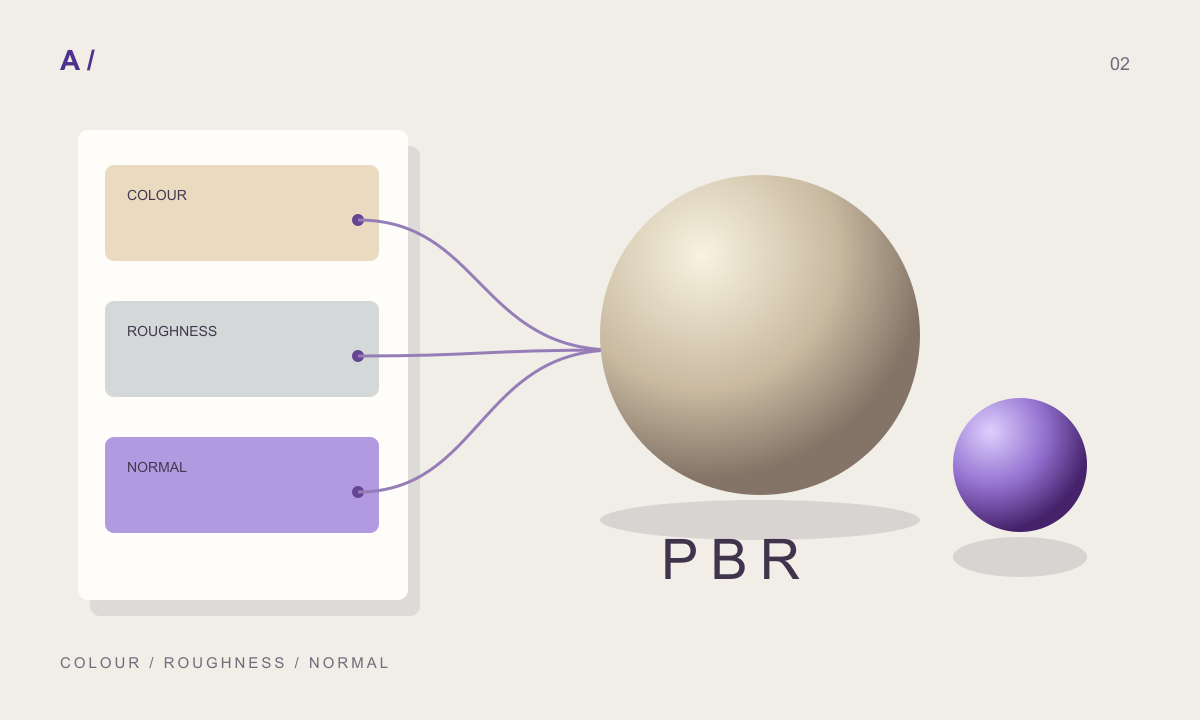
For 600 × 1200 mm facade stone, a base name such as facade_stone_600x1200_v03 is understandable. Add channel suffixes for colour, normal and roughness. Keep a known product code in a separate field; visual similarity does not justify giving a library texture a real manufacturer identity.
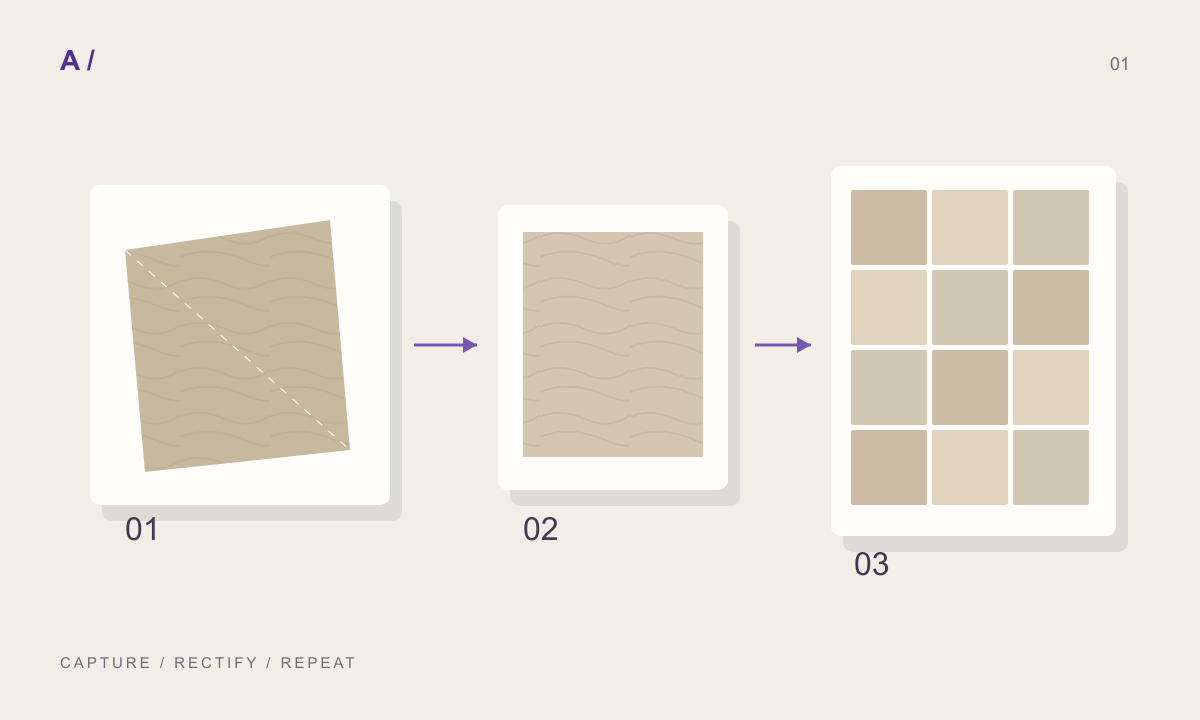
If the filename contains one unit’s dimensions, record full repeat coverage in the handoff note. Date and version serve different purposes: one records when the package was prepared, the other its revision sequence. Use a numbered version and a short change note instead of final, final2 or new_final. The system should remain clear after several revisions.
Separate sources, derived files and product documents
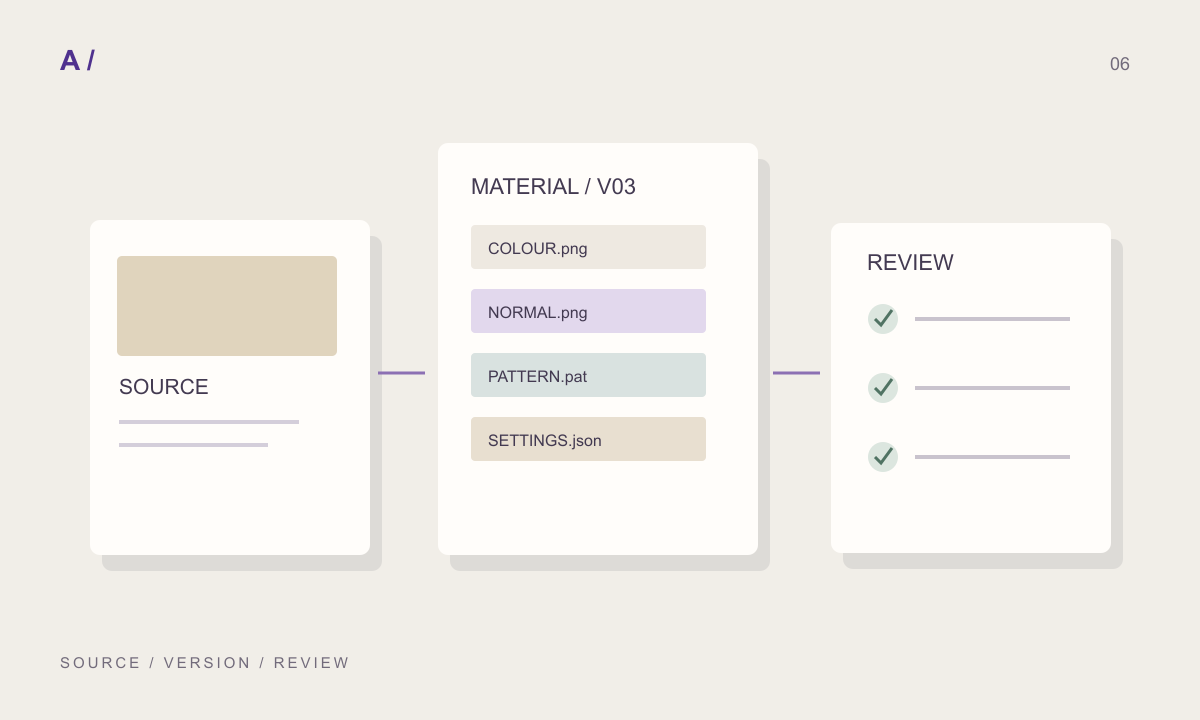
Keep the original source separate from edited outputs. Supplied scan channels and maps derived later from colour should not be presented as the same type of evidence. A source link and licence note help the next person understand where the material came from and investigate discrepancies.
A manufacturer datasheet is meaningful when linked to the actual product. A similarly coloured digital reference is not automatically a scan of that product. Both can be included in the package, but their roles should remain explicit. This is especially useful when specification and visualisation are handled by different people.
Record what was actually reviewed
Checked is not a complete review record. Which package was opened in which software version, on what test surface? Did scale, orientation and repeat count match the expectation? Add the date and the person or team responsible for the review.
Counting expected slabs across a 3.6-metre wall provides a concrete scale check. It does not establish fire or slip performance. Numerical file checks, in-application tests and physical product suitability are different subjects. Avoid collapsing them into one verified badge. A narrowly described check is more useful because another person can understand its limits and repeat it.
Refresh every affected output when the layout changes
Changing a joint dimension but updating only the rendered image can leave an older layout in the drawing. Record the changed setting and prepare affected maps, hatch files and the package under one revision. Archive the older version so it cannot be mistaken for the current delivery.
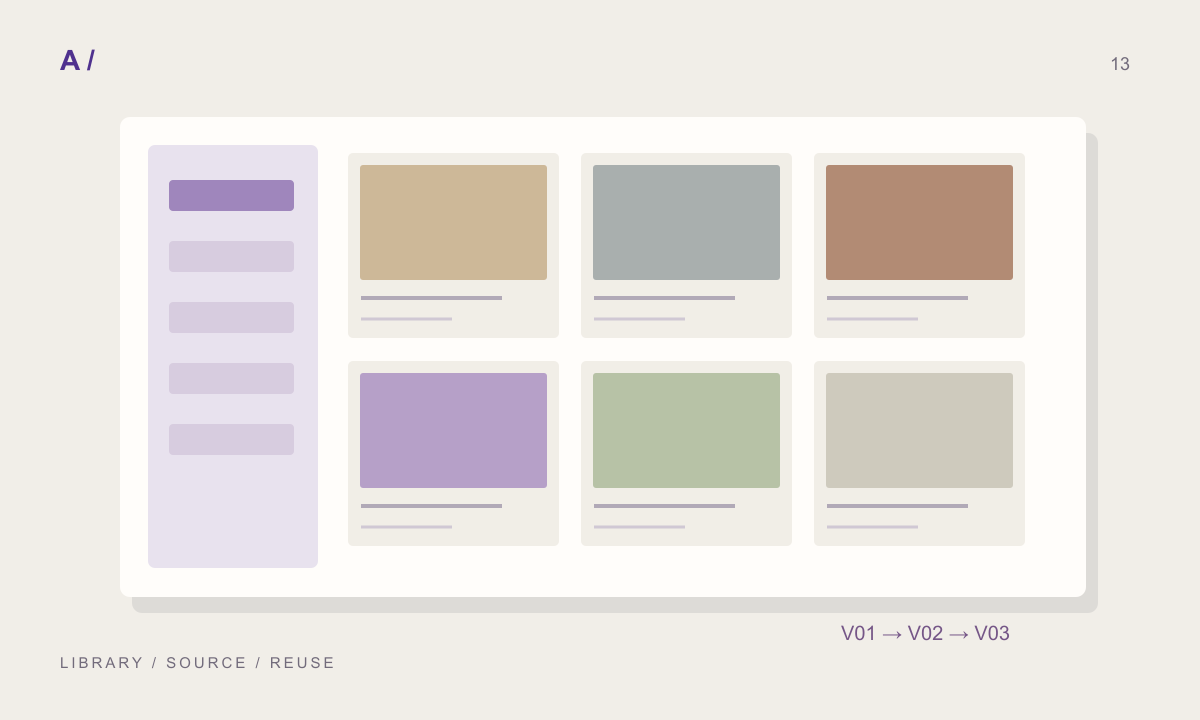
Reopening a saved MATERIALHAUS material reduces the need to reconstruct its dimensions and pattern decisions. Destination-specific settings still need their own record. Do not assume a new package inherits an old review result automatically. Recheck dimensions and orientation affected by the change, while retaining the earlier record for traceability.
Open the package as if you were the recipient
Test the package from a location outside your working folder. Are texture paths still pointing to the original directory? Is it clear which file to use? Can you establish the correct physical coverage using only the included information? This short exercise reveals missing notes and fragile file dependencies.
Finish the handoff note with known limitations and the next required step. If a PAT has not been checked in Revit, state that explicitly rather than letting a successful download stand in for validation. A good handoff is not about producing more documentation. It preserves enough information for the next person to continue without repeating the same questions.
Before you hand off
- Channel and revision names are clear.
- Unit dimensions and full coverage are recorded.
- Sources, derived maps and product documents are distinguished.
- Review notes identify software and package versions.
- The package was reopened from another location.
- Known limitations and the next action are stated.
Frequently asked questions
Do I need a separate original package for every application?
Keep a shared source and separate application-specific setups. This distinguishes source revisions from renderer adjustments.
Is sending a ZIP enough?
A ZIP collects files. It does not explain scale, channel roles or revision status unless that information is included.
Prepared by MATERIALHAUS with AI assistance. Worked dimensions are illustrative; verify construction details and technical product information for your own project.